Three and a half centuries ago, Blaise Pascal wrote that all of humanity’s problems stem from our inability to sit quietly in a room alone.
Try it. Sit still for a minute, do nothing, and notice what shows up.
For me, it’s worry: the feeling that I’m not doing enough, that something is still unfinished. I sit on the porch and look at a tree, and one by one the undone tasks come begging for attention, like a baby that won’t settle until I pick it up. I can’t sit with the tasks, so I reach for my phone and open Clash Royale. The worries stop. The game is fun. I have lost an hour of my day.
Your temptation might be a feed, your messages, or the news. The pattern is the same. Something stressful is waiting: the email you’ve been dreading, paperwork that’s due, an unpaid bill. Your hand moves to the phone before you’ve decided anything. Forty minutes later, the stress has eased. The task hasn’t moved, and you have less time to do it.
What pulls us out of our lives like this?
Two things. The first is the phone. Its apps were built to capture your attention and keep it: feeds with no end, videos that start the next one for you, alerts timed to call you back. The second is your own brain, doing what brains do: reaching for relief. Stress arrives, the phone offers relief, and the next time stress arrives we reach a little faster. That is a self-sustaining loop. It isn’t a lack of willpower or a flaw in your character. Anyone can fall into the loop. Seeing it is the first step out.
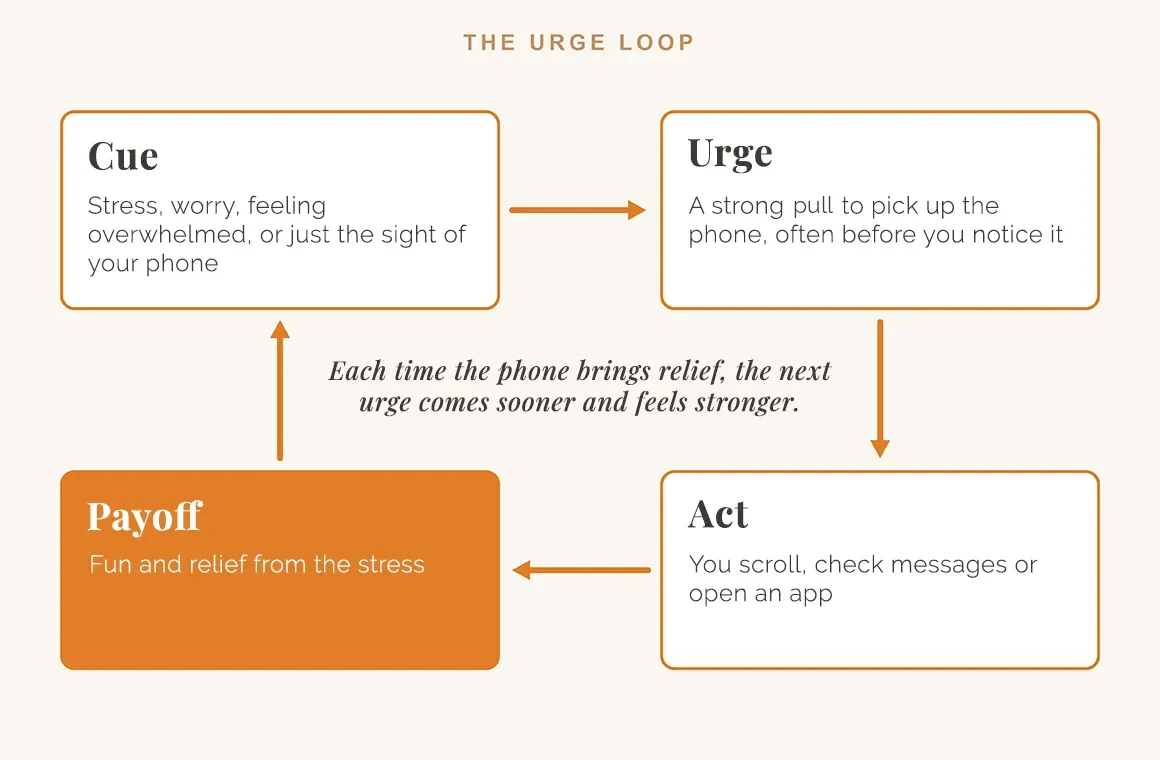
The loop has four parts.
Cue: stress, worry, feeling overwhelmed, or even just the sight of your phone on the desk.
Urge: a strong pull to pick up the phone, often before you notice it.
Act: you scroll, check messages or open an app.
Payoff: fun and relief from the stress.
Try this. Put your phone face down in front of you and just watch it. Feel the pull? Listen to your mind arguing with itself: This is a colossal waste of time. Then, one second later: Look at the phone. It’s fun. That tug-of-war is the urge.
Those good feelings are a powerful teacher. Each time the phone makes you feel better, your brain learns that stress plus phone equals relief. So the next time stress shows up, the urge comes sooner and feels stronger, until picking up the phone happens almost by itself. Meanwhile, the stressful task waits and grows.
Strangely, scrolling doesn’t even have to be fun to keep the loop going. In one study of 749 adults, the more heavily people used social media, the stronger their urge to use it became, while their enjoyment stayed the same (File and colleagues, 2022). The phone is one case of a wider pattern. Researchers who study procrastination describe it as feeling better now at the expense of your future self (Sirois and Pychyl, 2013). In a classic study, university students who put off their work felt less stressed early in the semester. By the end, they reported more stress and more illness, and they got lower marks (Tice and Baumeister, 1997).
Four ways to break the loop
1. Change the setting. Place your phone in a different room or drawer while working on the stressful task and disable notifications for that hour. In one study, students who got a call or text alert during an attention task made more errors, even though they didn’t answer it (Stothart and colleagues, 2015).
2. Block the path. Decide ahead of time with an if-then plan that names the exact moment: “If I open the report and feel the urge to pick up my phone, I’ll put it in my bag and set a 25-minute timer.” Setting up small barriers helps too, like logging out of an app or moving it off your home screen.
3. Notice the urge, then choose. Catch your hand moving toward the phone. Pause for one slow breath and name what’s happening: “There’s the stress urge.” Don’t obey it, and don’t fight it. Urges behave like waves. Left alone, they rise, peak and fall. Once the wave has passed, choose: back to the task, or a real break with a definite end time. And if you choose the phone, enjoy it. The aim isn’t to ban the fun, but to choose it instead of being pulled into it. This works even when the urge is strong. In one study, student smokers taught to watch their urges rather than act on them smoked less over the following week than untrained smokers (Bowen and Marlatt, 2009).
4. Build what matters. The point of breaking the loop is to spend your time on the people and things you care about. Find breaks that leave you better off: a short walk, a cup of tea outside, a call with a friend instead of a scroll through their posts.
You don’t need all four to break the loop. Pick the one that seems most helpful, and start there.
Back to the real world
My own way out of the loop is to build what matters: I fill my days with things that ask more of me than the phone, and give more back. I go to the gym. I coach a sports team. I talk with my kids, and with my wife. I still play Clash Royale, and I still lose myself in a feed now and then. But more and more, I place myself where life carries weight: real gravity, real people, real stakes.
And sometimes, when I’m back on the porch and the worries come begging for attention, I leave the phone in my pocket. I let the urge rise and fall. I watch the tree a bit longer.
Pascal was right. It’s hard to sit quietly in a room alone. Step outside, and the tree remains, waiting for us to look up.
References
Bowen, S., & Marlatt, A. (2009). Surfing the urge: Brief mindfulness-based intervention for college student smokers. Psychology of Addictive Behaviors, 23(4), 666-671. https://doi.org/10.1037/a0017127
File, D., Bőthe, B., File, B., & Demetrovics, Z. (2022). The role of impulsivity and reward deficiency in “liking” and “wanting” of potentially problematic behaviors and substance uses. Frontiers in Psychiatry, 13, 820836. https://doi.org/10.3389/fpsyt.2022.820836
Pascal, B. (1670/1995). Pensées (A. J. Krailsheimer, Trans.). Penguin Classics.
Sirois, F., & Pychyl, T. (2013). Procrastination and the priority of short-term mood regulation: Consequences for future self. Social and Personality Psychology Compass, 7(2), 115-127. https://doi.org/10.1111/spc3.12011
Stothart, C., Mitchum, A., & Yehnert, C. (2015). The attentional cost of receiving a cell phone notification. Journal of Experimental Psychology: Human Perception and Performance, 41(4), 893-897. https://doi.org/10.1037/xhp0000100
Tice, D. M., & Baumeister, R. F. (1997). Longitudinal study of procrastination, performance, stress, and health: The costs and benefits of dawdling. Psychological Science, 8(6), 454-458. https://doi.org/10.1111/j.1467-9280.1997.tb00460.x
Frequently Asked Questions
Why do I reach for my phone when I’m stressed?
Two things pull together. The apps are built to hold your attention, with feeds that never end, videos that start the next one for you and alerts timed to call you back. And your brain reaches for relief. Stress arrives, the phone offers relief, and the next time stress arrives you reach a little faster. It isn’t a flaw in your character.
Is it a lack of willpower if I can’t put my phone down?
No. Anyone can fall into the loop. Each time the phone makes you feel better, your brain learns that stress plus phone equals relief, so the urge comes sooner and feels stronger. Seeing the loop is the first step out of it.
What can I do when the urge to pick up my phone shows up?
Pause for one slow breath and name what is happening: “There’s the stress urge.” Don’t obey it and don’t fight it. Urges behave like waves, and left alone they rise, peak and fall. When the wave has passed, choose between going back to the task and taking a real break with a definite end time.
Does putting my phone in another room really help?
It takes the cue away. Even the sight of your phone on the desk can set the loop off, and an alert you never answer can still pull your attention from the task. Putting the phone in another room or a drawer while you work, with notifications off for that hour, takes both out of play.
When is it worth seeing a psychologist about reaching for my phone to escape stress?
When the phone has become your main way of handling stress and the things you have been avoiding are piling up, or you are losing time from the people and things you care about. A GP can set up a Mental Health Treatment Plan, and our page on Mental Health Treatment Plans explains how that works.

General information only. This article does not constitute clinical advice or a substitute for individual assessment. If you are in crisis or at immediate risk, please contact 000 or Lifeline on 13 11 14.