One sentence about us humans sits at the bottom of this article. Please don’t scroll down yet.
But notice how you feel now. A moment ago, no question existed. Now a gap has opened: uncertainty. The mind wants it filled.
What does the sentence say?
Let’s leave it there. No guessing. No scrolling. Just notice the feeling.
At the core of many anxieties is a desire for certainty. Anxiety speaks in “what ifs”. What if the pain is serious? What if I said the wrong thing? What if everything goes wrong? Then anxiety demands an answer.
So we worry. Worry is the mind’s search for certainty. We check for danger, or ask for reassurance, or look up the symptom at 2am, or over-prepare, or avoid anything risky, and then we check again.
Name your own habit. Pick one.
Chasing certainty has costs.
Relief fades fast. Each check buys minutes of calm. Then doubt returns, demanding another check.
Worry takes over, and life gets smaller. Love, children, health, work: almost everything we care about is uncertain. If we must feel sure first, we hold back. We skip the trip, dodge the hard conversation, turn down the job. Even when we show up, worry occupies our attention. We sit at the dinner, the beach, the child’s game, and barely notice them.
So what can we do? The aim is not stopping the pull. The aim is noticing it, then choosing.
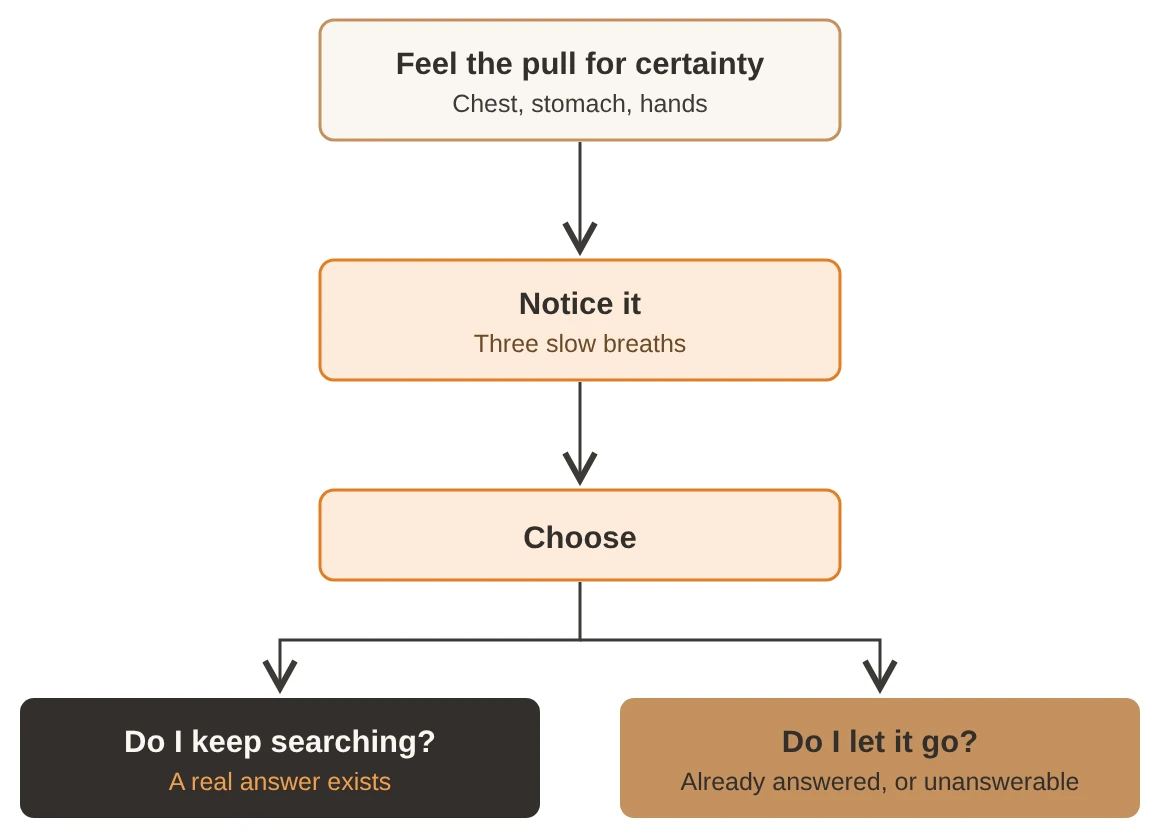
Feel the pull. The urge for certainty appears in the body early, often before we realise we are worrying. It might appear as chest tightness, a sinking stomach, or a restless hand reaching for the phone. Because the body gives the earliest warning, it is the best place to catch the urge before it takes over.
Try it now. The sentence at the bottom of the article remains unread. Notice the urge to scroll down. Then move your attention slowly through your chest, stomach, throat and hands, and find where that urge is strongest.
Notice it. Keep your attention on that spot for three slow breaths, without trying to push the feeling away or fix it. Simply make room for the sensation and observe whether it grows, shrinks or moves.
Choose. Those three breaths create a pause, and a pause gives us a choice that the automatic reaction never offered. Ask yourself a single question: is there a real answer available to me?
Do I keep searching? Yes, when someone can give a real answer. See the doctor about the pain. Ask your friend whether your words upset her. Get the answer once, then stop checking.
Do I let it go? Sometimes the answer has already arrived, and we keep checking anyway. Sometimes no amount of “what if” thinking helps, because there is no answer to find. Not every question can be answered. Will I stay healthy? Will this relationship last? Much of life is still undecided, and thinking harder cannot decide it.
Then we leave the question open. We return to the present: the meal, the conversation, the work. Letting go does not mean the anxiety leaves. It may ease, or it may stay for a while. Letting go means we stop feeding the question and carry on with our day, even with a tight chest.
You can decide now: the sentence below remains unread. Scroll down and read it, or close the page and leave the question open. Either choice is fine. This time you are choosing, not reacting.
“Everything still to come lies in uncertainty: live now.”
Seneca, two thousand years ago
Frequently Asked Questions
Why can’t I stop worrying until I know for sure?
Anxiety speaks in “what ifs”, and each one feels as if it needs an answer before you can relax. So the mind goes looking. You reread a message or ask one more person, and you feel better for a few minutes. Then the next “what if” arrives. Because the relief doesn’t last, the checking tends to repeat.
Is it wrong to check things or look up symptoms when I’m worried?
Not when the question has a real answer. If a pain worries you, see a doctor and get the answer once. The trouble starts when we keep checking after the answer has arrived, or go looking for a certainty that doesn’t exist.
How do I know whether to keep searching or let a worry go?
Ask whether a real answer is available to you. A doctor can tell you what a pain is, and a friend can tell you whether your words upset her. Nobody can tell you whether you will stay healthy or whether a relationship will last. Those questions stay open, and thinking harder doesn’t close them.
Does letting go of a worry mean the anxiety goes away?
Not necessarily. The anxiety may ease or it may stay for a while. Letting go means you stop feeding the question and carry on with your day, even with a tight chest.
When is it worth seeing a psychologist about constant worry?
When checking or seeking reassurance is taking up a large part of your day, or you have started avoiding things you care about because you can’t be sure how they will go. A GP can set up a Mental Health Treatment Plan, and our page on Mental Health Treatment Plans explains how that works.
General information only. This article does not constitute clinical advice or a substitute for individual assessment. If you are in crisis or at immediate risk, please contact 000 or Lifeline on 13 11 14.