
I miss my young children. Now that they have grown, I miss seeing the world through their eyes. I shared their excitement as they watched waves crash against a rocky cliff, discovered the secret spot under the house, and marvelled at a little snail crossing the grass. I loved watching videos with them, especially Monsters Inc., Toy Story, and all kinds of anime and cartoons. If I watch the same videos now, I find them pretty boring. Nothing about them has changed, except that I am no longer watching through my children’s eyes.
Our love for other people expands our experience of life. Treating them as tools or threats shrinks it.
I-It and I-Thou
The philosopher Martin Buber described two ways of meeting anything: a person, a tree, even God. He called them I-It and I-Thou, where “thou” is simply an old word for “you”.
I-It is how we treat things we use, sort, or study. We stand back and judge people by usefulness or danger: tool or threat. Hurry turns a checkout worker into two scanning hands. Anxiety turns party guests into judges. A late school morning turns our child into a problem.
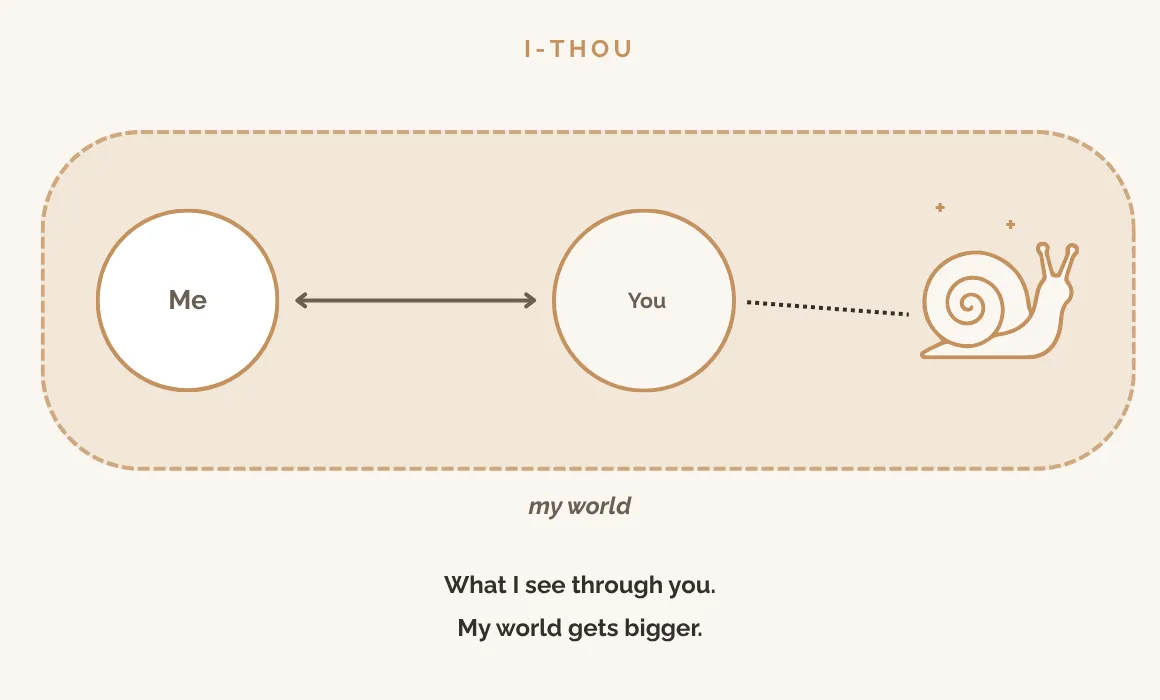
I-Thou is a real meeting with the other. We bring our whole self and meet a whole presence, never a tool. Between people, I-Thou means true connection: experiencing life through each other. Buber believed we can meet trees, even God, this way.
Put briefly, I-It is the world we observe and use, whereas I-Thou is the world we meet and are changed by.
Remember the little snail my son saw crossing the grass? If I had been in a rush that morning, I might have treated him as a problem to hurry along. I would have seen a delay, not a snail. I wouldn’t have wondered what he was seeing, any more than I wonder what a hammer sees. My world would have stayed small: just mine.
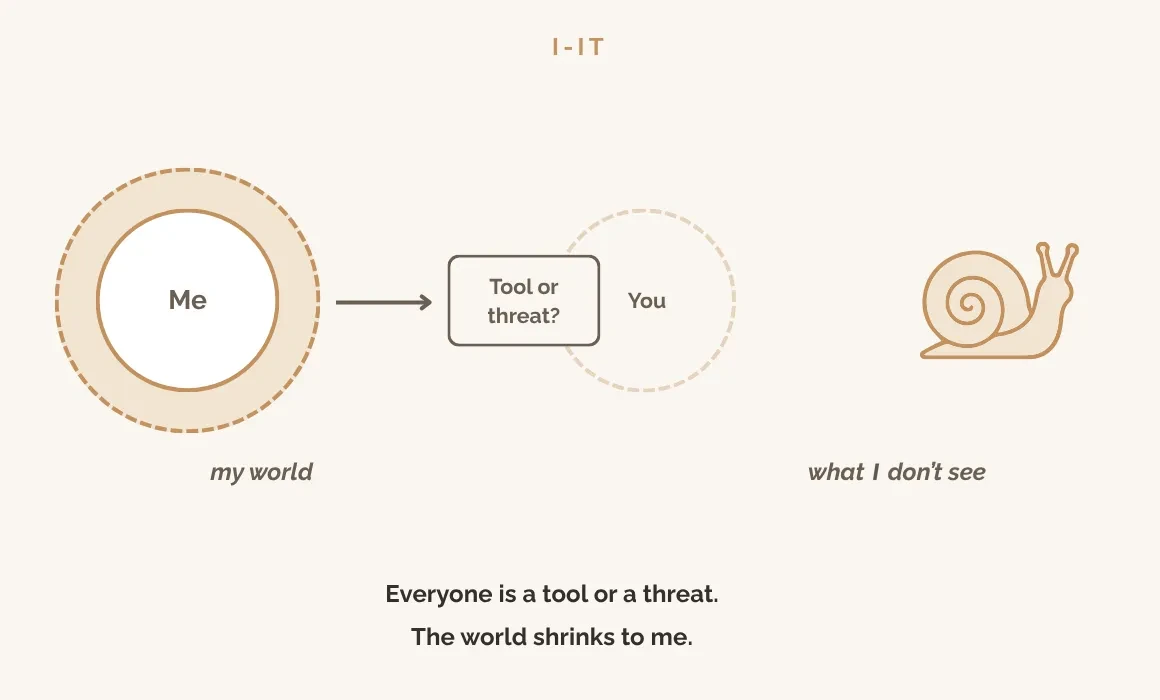
But I wasn’t in a rush. I crouched down beside him, and his wonder became my wonder. For a moment, my world was twice as big. That is I-Thou.
Gains and costs
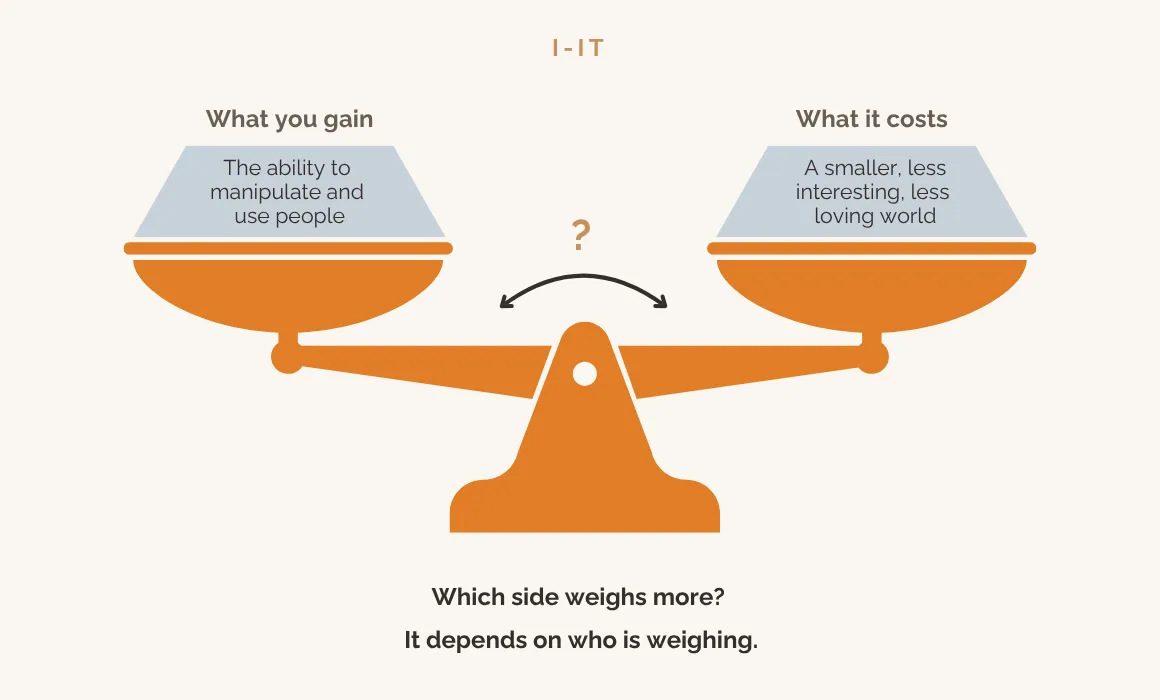
Each way of meeting the world has its gains and its costs. I-It isn’t bad. We rely on it every day: ordering a coffee, paying a bill, asking for directions. In those moments we see people from the perspective of what they can do for us, and that’s fine. Most of us also slip into it when we’re tired, hurt, or afraid.
The trouble starts when we never step out of that perspective. Some people live mostly inside it. We tend to call them manipulators, narcissists, psychopaths, or users, because they see other people as tools, as extensions of themselves, or as enemies to be controlled and defeated. What they gain is the ability to manipulate and use people, and because they are so focused on their own aims, they sometimes succeed and gain power. But there is a cost. Their world is smaller, less interesting, and less loving.
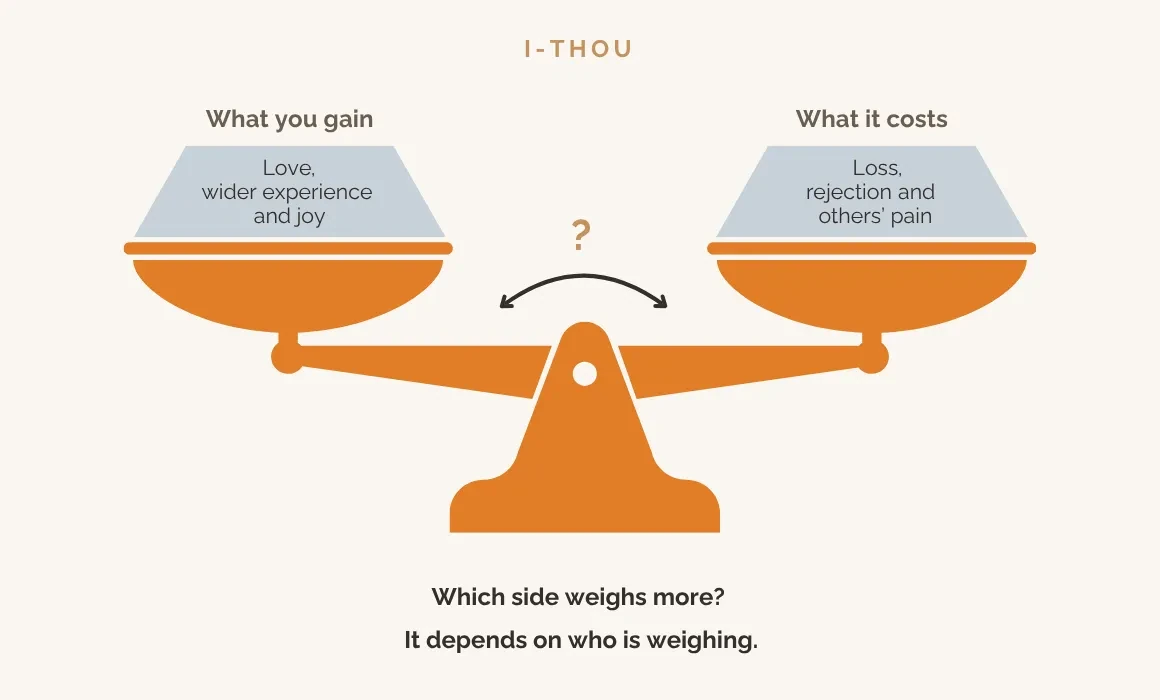
I-Thou has its own gains and costs. Love brings joy and wider experience. It also brings pain and loss. Other people’s pain becomes ours. And we can lose them: they can reject us, fall out of love with us, or die.
Turning toward, turning away
Every time we meet someone, we lean one way or the other. We can turn toward them, or we can turn away and see only what they can do for us. Neither stance is chosen once and for all; each of us does both, many times a day. But over a life, one tends to win.
If we mostly turn away, we gain the ability to manipulate and use people. People may fear us, but they will not love us, nor will they really know us.
If we mostly turn toward, we will know love, friendship, laughter, and a wider experience of life, but we will also feel grief, pain, and sadness.
Which way will you lean?
If you could never grieve again, but only by never loving again, would you take that deal?
Would you give up loving your child so you’d never have to fear for them?
References
Buber, M. (1937). I and Thou (R. G. Smith, Trans.). T. & T. Clark. (Original work published 1923)
Frequently Asked Questions
What do I-It and I-Thou mean?
They are two ways of meeting anything, set out by the philosopher Martin Buber. I-It is how we treat things we use, sort or study, judging people by whether they are useful or dangerous. I-Thou is a real meeting, where we bring our whole self and meet a whole presence, never a tool.
Is it wrong to treat people as tools sometimes?
No. We rely on I-It every day when we order a coffee, pay a bill or ask for directions, and it’s fine to see people by what they can do for us in those moments. Most of us also slip into it when we’re tired, hurt or afraid. The trouble starts when we never step out of that way of seeing people.
How does anxiety change the way I see other people?
Anxiety can turn people into threats. A party full of guests becomes a room of judges, and a late school morning turns a child into a problem to hurry along. Noticing that shift is the first step towards turning back toward the person in front of you.
What does it cost to turn toward people?
Love brings joy and a wider experience of life, and it also brings pain and loss. Other people’s pain becomes ours, and we can lose them if they reject us, fall out of love with us or die. Turning away avoids some of that pain, but the world gets smaller, less interesting and less loving.
When is it worth seeing a psychologist about keeping people at a distance?
When you notice you are holding people away to stay safe, or your world has become smaller than you want it to be. A GP can set up a Mental Health Treatment Plan, and our page on Mental Health Treatment Plans explains how that works.

General information only. This article does not constitute clinical advice or a substitute for individual assessment. If you are in crisis or at immediate risk, please contact 000 or Lifeline on 13 11 14.